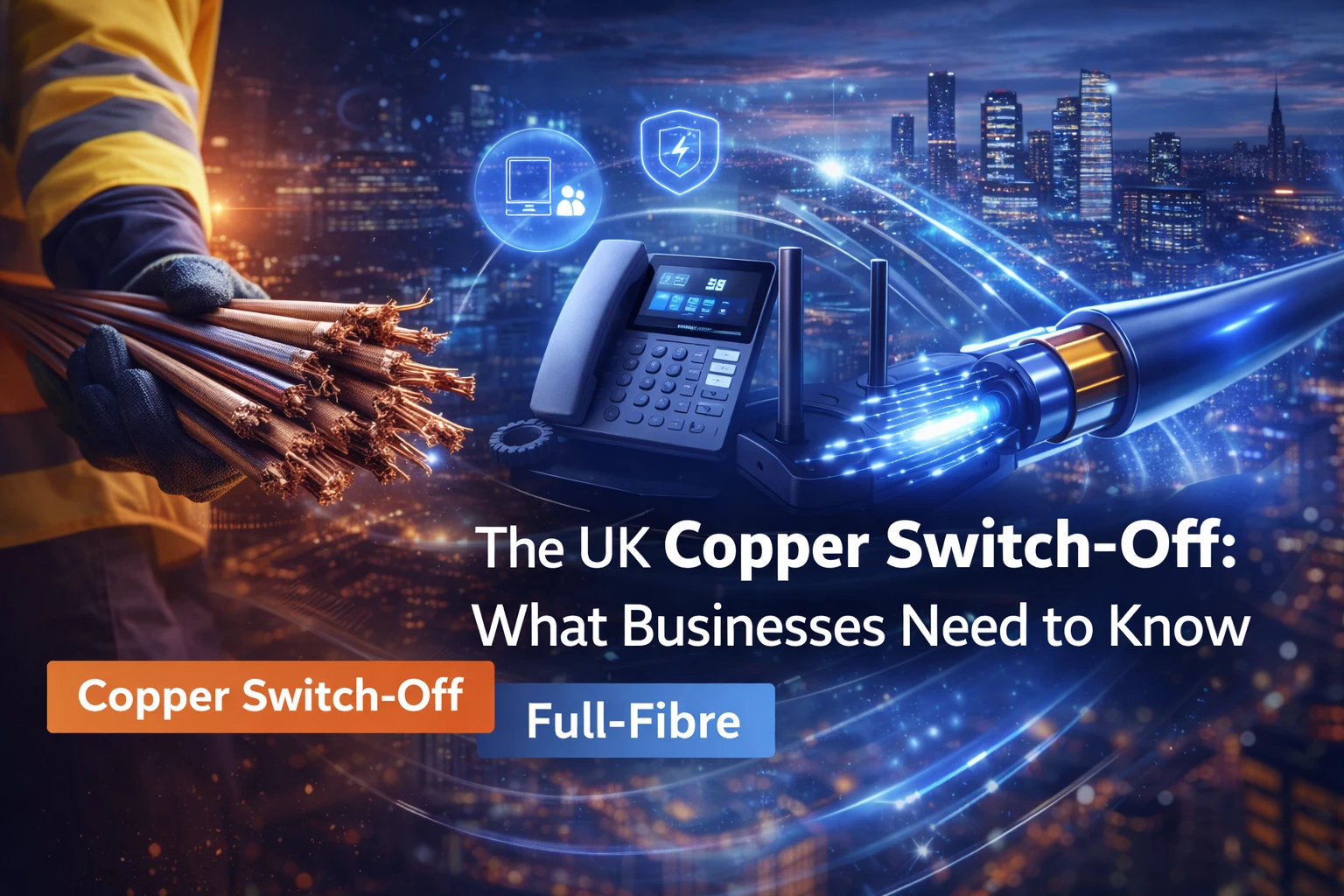
Traditional analogue phone lines and broadband services delivered over copper cables are being retired and
replaced with full-fibre technology.
If your business still relies on PSTN phone lines, ADSL, FTTC broadband, fax machines, lift lines, alarm
signalling, or legacy payment terminals, this change directly affects you.
What Is the Copper Switch-Off?
The copper switch-off refers to the retirement of the Public Switched Telephone Network (PSTN) — the analogue
phone system that has powered UK communications for over 100 years.
By January 2027, Openreach and other providers will permanently shut down copper-based services, moving everyone
onto:
- Full Fibre (FTTP) broadband
- VoIP (Internet-based phone systems)
- All-IP communications
This means traditional landlines will no longer work unless converted to digital.
Why Is Copper Being Retired?
Copper infrastructure is aging, expensive to maintain, and unable to support modern digital demands.
Key reasons for the transition:
1. Reliability
Copper cables degrade over time and are vulnerable to weather, water ingress, and interference.
2. Speed & Capacity
Fibre delivers gigabit speeds and supports modern cloud services, CCTV systems, and remote working.
3. Future-Proofing
Digital networks enable smarter services such as IoT, AI integrations, and unified communications.
4. Cost Efficiency
Maintaining two networks (copper + fibre) is inefficient for providers.
How Will This Affect Businesses?
Many organisations don’t realise how many critical systems rely on analogue lines.
Services That May Stop Working
- Traditional phone lines
- Fax machines
- Lift emergency phones
- Intruder & fire alarm diallers
- Door entry systems
- PDQ card machines
- Legacy broadband connections
Without planning, these could fail when copper services are withdrawn.
What You Should Do Now
1. Audit Your Current Services
Identify every device using a phone line — not just your handsets.
2. Upgrade to Fibre Broadband
Full Fibre (FTTP) is the long-term replacement for copper broadband.
3. Move to VoIP Telephony
Cloud phone systems provide more features at lower cost.
4. Update Critical Systems
Ensure alarms, lifts, and emergency lines support IP or GSM solutions.
5. Plan for Power Backup
Unlike analogue lines, digital services require electricity to operate.
Benefits of Switching Early
Businesses that migrate sooner gain immediate advantages:
- ✔ Faster, more reliable connectivity
- ✔ Lower call costs
- ✔ Advanced call handling features
- ✔ Better support for remote work
- ✔ Improved resilience
How Vivid Telecom Can Help
As a business telecom provider, Vivid Telecom Ltd can manage the entire migration process:
- Fibre broadband installation
- VoIP phone systems
- Alarm and lift line upgrades
- Network infrastructure
- Ongoing support
We provide a complete transition plan to ensure your organisation stays connected before the deadline.