Before You Blame the VoIP Company… Check Your Onsite Equipment
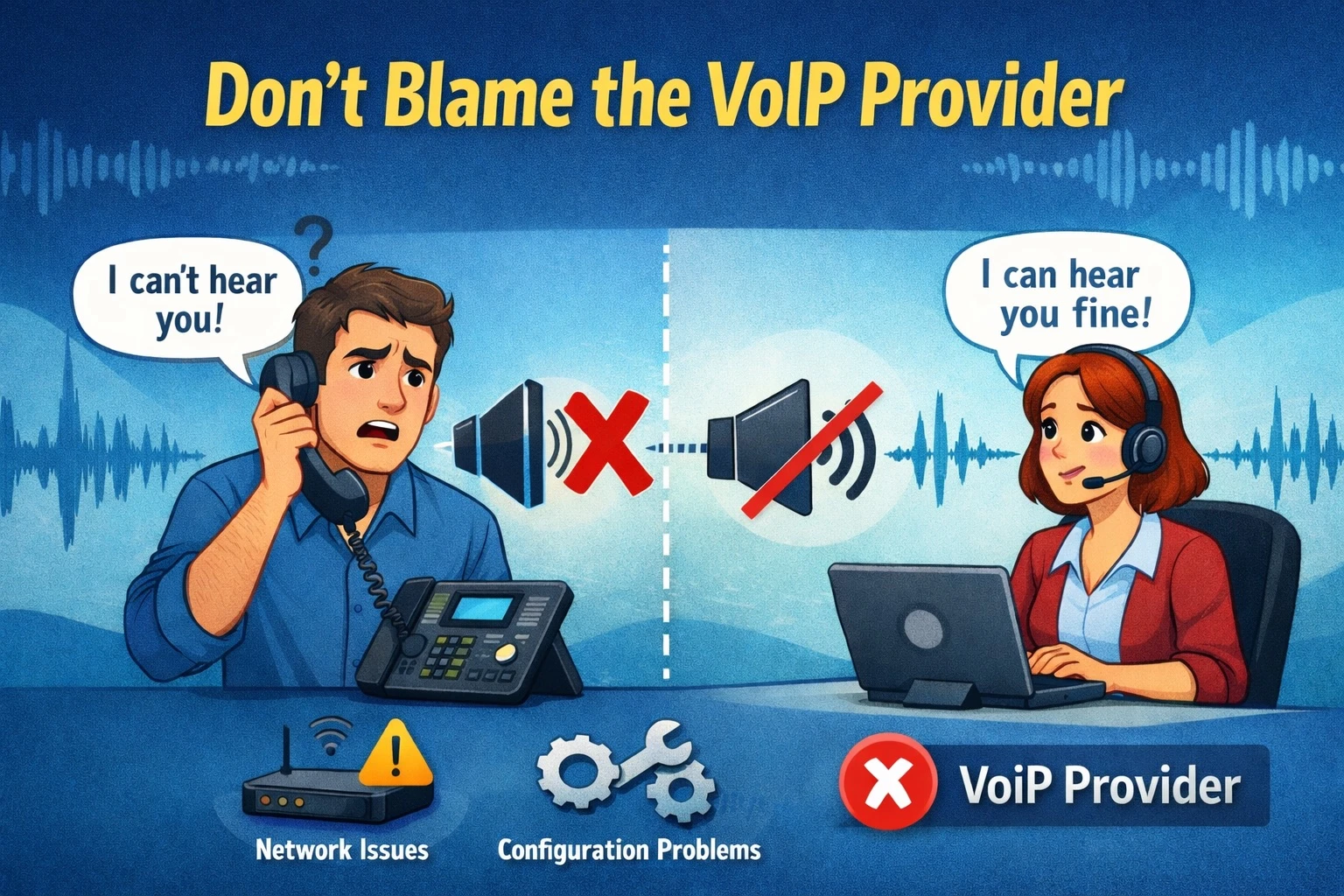
One-way audio is one of the most common complaints with VoIP systems.
You can hear the other person — but they can’t hear you.
Or they can hear you — but you can’t hear them.
The first reaction?
“It must be the VoIP provider.”
But in many cases, the real issue is sitting inside your own building.
As a provider working with businesses across the UK at Vivid Telecom Ltd, we regularly find that the phone system itself isn’t the problem — the onsite infrastructure is.
Let’s break it down.
1️⃣ Old or Poor Network Cabling
If your building still has:
- Old Cat5 wiring
- Poorly terminated RJ45 connections
- Damaged patch leads
- Loose patch panel connections
You’re already at risk.
VoIP relies entirely on stable data transmission. If packets are being dropped due to wiring faults, you’ll experience:
- One-way audio
- Choppy calls
- Calls dropping completely
Unlike traditional analogue phones, VoIP has zero tolerance for poor network conditions.
2️⃣ Power over Ethernet (PoE) Limitations
Power over Ethernet (PoE) is brilliant — one cable delivers both power and data.
But here’s the part many businesses forget:
👉 Each PoE port typically provides a maximum of 30W (PoE+).
👉 The entire switch also has a total power budget.
Now think about what’s connected:
- IP phones
- CCTV cameras
- Access control panels
- WiFi access points
If your switch’s power budget is maxed out, devices won’t receive stable power.
What happens next?
- Phones randomly reboot
- Audio cuts out
- One-way audio appears
- Devices partially initialise
And suddenly the VoIP system gets blamed — when it’s actually a power issue.
3️⃣ Network Congestion & Bandwidth Priorities
If you’re running:
- Cloud backups
- CCTV remote streaming
- Large downloads
- Multiple users on Teams/Zoom
Without proper QoS (Quality of Service) configured on your router or firewall, voice traffic competes with everything else.
VoIP packets are small and time-sensitive. If they’re delayed or dropped, you’ll hear it immediately.
4️⃣ The Simple Test: Call Recording
Here’s a quick way to identify where the fault lies.
If your system supports call recording:
- Make a test call.
- Experience the one-way audio.
- Listen to the recording.
👉 If the recording captures both voices clearly, the VoIP platform is working correctly.
That means:
- The SIP call is fine
- The hosted system is fine
- The provider is fine
The issue is likely:
- Local network
- Switch
- Cabling
- Router
- Firewall configuration
This is one of the quickest ways to separate “provider fault” from “onsite infrastructure fault”.
5️⃣ It’s Not Always the Phone System
Modern hosted systems (like those deployed by Vivid Telecom Ltd) are extremely stable.
When one-way audio occurs, it is commonly caused by:
- SIP ALG enabled on a router
- Double NAT issues
- Incorrect firewall rules
- Insufficient PoE power
- VLAN misconfiguration
- Faulty patch leads
The VoIP system is often the last place the fault exists — but the first place people look.
Final Thoughts
Before raising a fault ticket and pointing fingers, ask yourself:
- When was your network last audited?
- Are you using enterprise-grade switches?
- Is your PoE switch within power budget?
- Are your cables tested and certified?
- Is QoS configured properly?
VoIP is only as strong as the network it runs on.
If you’re experiencing one-way audio issues and want a proper diagnosis rather than guesswork, start with your onsite infrastructure.
Because sometimes…
It’s not the VoIP company at all.